


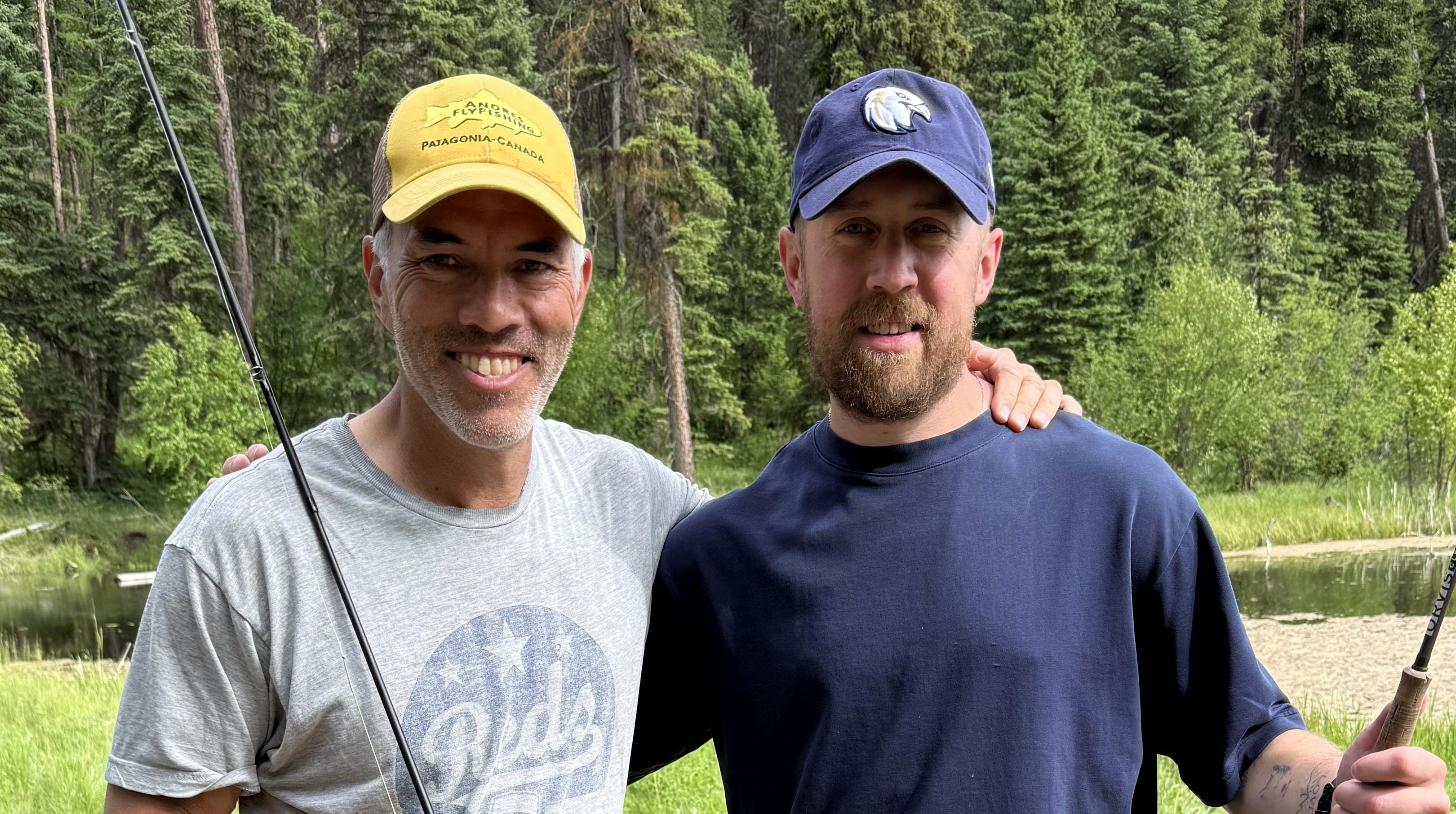
Note from Jim:
Hey family!
Long time no talk! To give you a little update, I signed a 3-book deal with Hachette Book Group on Valentine’s day, 2025. Inner Excellence, Best Possible Life, and the Inner Excellence workbook. The first two books are out, and the workbook is due to be published in January (The Inner Excellence 90-Day Challenge: A Workbook to Train Your Mind and Live the Best Possible Life) If you want to be a beta-tester (we’ve got a few more weeks of testing) just reply to this email or reach out here. I’ve been working hard on the workbook and thus have not had time to write the newsletter. But I’m making my way back! Soon I’ll write once a week again, and we’ll have live Q and R as well as other bonuses for paid members (it’s $7/month).
Our next Inner Excellence retreat open to the public is in September in New York. Find out more here. Our next YWAM Homes of Hope House build/Inner Excellence Retreat in Mexico is in November. So excited for both! Most attendees say the retreats are life-changing.
The article below was written by former NHL player Dustin Kohn. I hope you enjoy how he’s experienced and implemented Inner Excellence. I didn’t invite Dustin to write this, he wrote it on his own Substack and I saw it and asked if I could re-post.
Love Jim
PS
If Inner Excellence or Best Possible Life changed your life, I’d love to hear! And if you are up for writing an article about it, we’ll be taking guest posts on occasion.
There are two people who have changed the way I think more than anyone else. Both are named Jim.
Both have, in different ways, encouraged me to think more deeply about things than I otherwise would have, in a way that isn’t always comfortable or widely encouraged.
In a world where people often want certainty and instant gratification, I’ve come to see how difficult it can be to sit with uncertainty. This shows up not only in ideas, but in how we approach performance and life itself. Even among the people closest to me, this way of thinking can be met with skepticism or frustration, I think because uncertainty is uncomfortable, as is re-evaluating your belief system and the way you do things.
Both Jims, in their own way, point to the same idea: that reflection opens the door to something beyond ordinary performance and toward a more meaningful way of living.
The first was Jim Murphy. About nine years ago, I came across his work and had the opportunity to meet him. At the time, I was just finishing my professional hockey career, and my understanding of performance was entirely shaped by results. Success had meant making teams, earning ice time, signing contracts, and reaching the next level.
Through Inner Excellence, he introduced an idea I hadn’t really encountered before: that the highest aim in performance is not achievement, but who you become in the process when you commit to learning and growing every day. That reaching your potential comes from playing and living through love rather than fear, and from building an identity that is not dependent on outcomes.
I found the ideas compelling, but I don’t think I truly understood them at the time. I could explain them and agree with them, but I was still interpreting everything through the same assumptions I had always carried. Even when I accepted the words, I was still filtering them through a worldview built on achievement and external validation.
A few years later, I met Dr. Jim Denison while studying at the University of Alberta. He didn’t approach coaching as a set of answers or methods, but as a way of thinking. Much of his teaching focused on helping us examine the assumptions we were operating from without realizing it.
That idea had a quiet but lasting effect on me. Many of us move through sport and life with assumptions that feel like reality simply because they are familiar. We rarely stop to question where they come from or whether they still serve us. One of the central questions he encouraged us to explore was what would happen if the assumption itself was flawed.
Over time, that way of thinking began to reshape how I interpreted my experience in hockey and in life. It eventually led me back to something I had heard years earlier from Jim Murphy, but hadn’t been able to fully grasp at the time.
I had been operating under the assumption that achievement is the highest goal a person can pursue. Once I began to question that, I started to understand Murphy’s ideas differently because I had become more capable of seeing them.
In professional hockey, achievement is portrayed as everything. Progress is measured through external milestones. Making teams, signing contracts, and reaching new levels become the markers of success. Each one feels like it should bring confidence or fulfillment, but each achievement is quickly replaced by the next goal. The finish line keeps moving because the underlying expectation remains unresolved.
Over time, I began to see a pattern I hadn’t recognized while I was inside it. The problem was not that my goals were too big, but that they were too small. They were finite outcomes.
I have also come to believe that most high-level athletes and performers sense this. I’ve had many conversations with former professional athletes who, once they step away from the environment and have space to reflect on their careers and life more broadly, arrive at a similar understanding. There is often a recognition that this way of framing success is manufactured. It reflects the structure of the system we operate in, not necessarily the deeper truth of what drives performance, human potential, or fulfillment.
When identity becomes attached to finite outcomes, performance changes in subtle ways. The closer a person gets to a goal, the more pressure tends to build. The moment stops being an opportunity to express ability and becomes something to protect. Attention shifts from presence to consequence. The experience becomes less about expression and more about evaluation.
This is where performance becomes constrained. When something feels tied to identity, the nervous system responds accordingly. People become more cautious and controlled, and less willing to take the kinds of risks that allow full expression. Attention narrows, creativity decreases, and focus shifts from the task itself to the implications of the outcome.
The more I reflect on this, the more I see it extends well beyond sport. It is reinforced by the broader culture we grow up in. From an early age, success is defined through achievement. Education, sport, and work systems reward outcomes more than process, and over time it becomes natural to equate accomplishment with value. In many ways, work itself can become tied to identity in a deeper sense, where people quietly seek to justify their existence through what they produce or achieve, often without even recognizing it.
At the same time, a different perspective becomes clearer when people are at the end of their lives. Accounts from palliative care and end-of-life research consistently show that people rarely reflect on achievements as the most meaningful parts of their lives. They speak more about relationships, love, presence, courage, and whether they lived in a way that felt true to themselves. The emphasis shifts from what was achieved to how life was lived and who they became in the process. That contrast raises an important question about how we define success while we are still in the throes of it.
None of this is to suggest that achievement is unimportant. Excellence and ambition matter. Goals give direction and structure to effort. The issue arises when achievement becomes the highest aim rather than something that serves a larger way of living.
What I’m still learning to do is orient myself differently. I haven’t figured it out, but I now have a set of tools and a different way of seeing when I catch myself slipping into old assumptions. It’s something I return to often, and the truth is, it is very hard.
Because the world around us constantly reinforces the opposite direction. We live in a culture oriented toward visible markers of success: possessions, achievements, looks, money, status. These are constantly amplified and rewarded, talked about and pursued. Even when you intellectually understand there might be another way to live, you are still swimming in a current that pulls you back toward external validation.
I’ve come to learn there is another way to orient performance. Instead of making achievement the destination, the focus can shift toward what is possible for you. This means becoming more aware, more disciplined, more courageous, more present, and more engaged in the process of growth itself.
These kinds of goals are different because they do not have an endpoint. There is no point at which growth is complete or courage is fully developed. They are ongoing processes rather than fixed destinations. Every experience, whether “successful” or not, becomes part of that process.
When this shift happens, the meaning of performance changes. Outcomes still matter, but they no longer define the individual. Success and failure become sources of information rather than judgments of self-worth. Performance becomes less about protecting identity and more about capability and possibility.
In looking back, I see that both Jim Murphy and Jim Denison were pointing me in the same general direction, but from different starting points. Murphy gave me a philosophy of performance that emphasized becoming over achievement. Denison helped me develop the ability to question the assumptions that were preventing me from fully understanding it.
Together, they changed not only how I think about performance, but how I think about what it means to try to live a meaningful life. I’m grateful for both of them and the impact they’ve had on how I see things.
Thanks for sharing Jim!